


Creating a Conversion Execution Schedule
Budgeting has two parts: money and time. The fun part of spending the cash begins once budgeting is done.
The trick is to plan each conversion task in order to prevent any re-work or backtracking. We’ll start off with an example of the basic steps necessary for a van conversion:

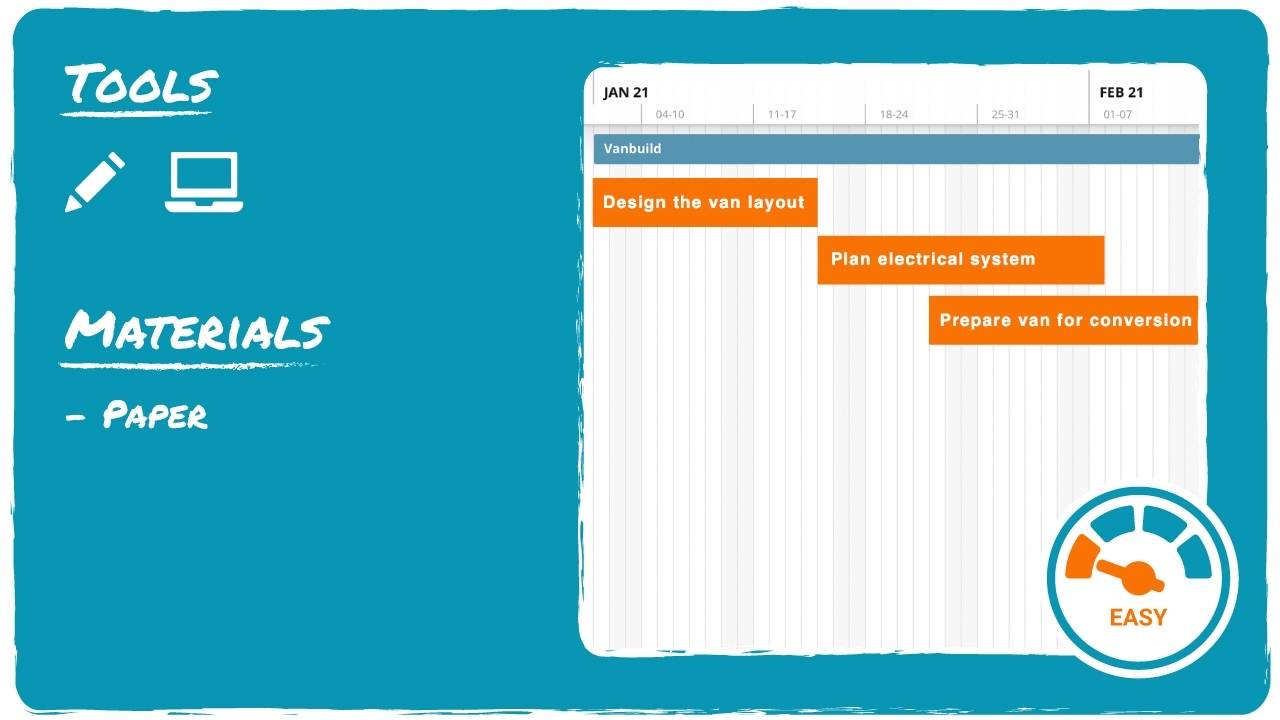
This is only a simple example. Make use of Google Calendar to create your schedule, and/or a Gaant Chart which allows you to visually map out deadlines, overlapping on certain tasks, as well as dependencies.
On the internet you will find plenty of free project management tools with the possibility to create a Gantt chart. This way you always have an overview of your vanbuild project:

Managing your time
Time management is one of the most important things during the van conversion to avoid losing track. The conversion of a van into a camper van is a very large project with many individual work steps.
You can easily lose the overview, especially if you are converting a van for the first time in your life.
Make sure you allocate enough time for the van conversion. It’s often difficult to estimate the duration of individual work steps beforehand. While some tasks are completed super fast, others might take an unexpectedly long time.
The problem with lack of time is that with too little time and too much pressure you will make more mistakes and stress yourself. Usually you overestimate yourself and time is always planned too short. A van conversion in one month is theoretically possible, but only with a reduction in quality and a lot of stressful working hours.
When planning the time it is also important to consider the condition of your camper van. If your camper is not quite that old, you will probably spend less time on paint and rust work than if you own a car that has its best times already behind it.
Of course, you should also consider the drying times for work steps such as painting. If you are working with varnish or wax, always add one or two days to allow everything to dry and soak in well.
Take enough time for your project. That way you can avoid mistakes. But there is also the flipside of the coin. You could delay the project and build on it for ages. To avoid this, you should set yourself very specific timetables and try to keep to them without stressing yourself too much.
In practice this often works out rather badly than well. But this way you personally stay on track and know what you have to do next without getting lost.
The graphic below will help you imagine how much time is needed for each step. Please note that the time required depends on your background knowledge in the different areas and the size of your project.
The estimated times should just give you a rough overview of the extent of the individual work steps.

Note that even with a detailed schedule, things may not always go according to plan. Be prepared for that.
Especially when you convert a van into a camper for the first time, it’s part of the process to adapt things according to the experiences made. Improvise as you go and be creative with your solutions. There is no perfect way of converting a campervan.
Sometimes you might also have the feeling that you will never be finished. To be honest this is always the case when converting a van. There is always something to do. Even on the road you can still get things done. So don't despair if you are not completely done by the planned date. You will have enough time on the road to do further adjustments, repair or maybe even add some small things.
Resources
This section is compiled from previous Van Life Academy members and other experienced vanlifers from within our community to provide more practical insights and opinions about this topic.
Expert Tips
Things we wish we knew before we started building our van. (common mistakes, money saving tips, and expert advice).
Don’t obsess over the tiny aspects, or you may never start the build. Focus too long on which LED strip lights to buy or what tanks fit best, and you’ll end up with paralysis by analysis. Aim to get the 6 van life essentials right before you leave and anything extra can be modified on the road. Ensure you have a comfortable place to sleep, whether it’s a hammock, sleeping bag or bed. Insulation is a must to keep you warm in winter and cool in summer. A place to cook, a separate place to poop and adequate freshwater storage for a few days off grid. Lastly, some way to charge your devices, whether by solar, portable battery pack or split relay. With these 6 items taken care of, your van becomes a mobile home on wheels. Upgrades can happen as you learn what matters most to you.
Giving notice to a landlord or job might be the first REAL realisation that your life is about to change forever. Ideally, your boss won’t be surprised. They may even be supportive, offering you a lighter workload or more suitable hours to help with the conversion. Landlords are not so much known for their support. Always give notice based on the worst-case scenario timeline, unless you have a friend with a spare couch or a parents pad that you can crash at while the van gets its finishing touches. Everything takes longer than we imagine it should, from priming, painting, building, fitting and so on. Don’t be fooled by aspirational time lapse videos. This level of design and quality of build is bound to take hours of workmanship to achieve.
How long does it take to build out an excellent van conversion? Well, how long is a piece of string? Some of us take longer at basic tasks. Some need to rely on qualified professionals and are subject to the contractors timelines too. Some people seem to push their van life experience from ‘empty shell’ to ‘farewell’ in a matter of weeks in a furious flurry of sawdust and soft furnishings. If you have adequate funds, a place to convert the van and a dependable friend or two to help, your conversion might take 3 weeks, or it might take 3 months. Building to very tight deadlines can be unreasonable unless you have all the time and money you need right away.
As evidenced by Joe from @liveinvans, everything takes forever, especially when you are impatient. “We went to paint the exterior of our medium wheel-based van, thinking it would be a weeklong job. 24 days later we were still applying the third coat of paint. It had rained incessantly the whole time, and even though we were parked indoors, the chilly air prevented the paint from drying effectively. The 72 hours wait really set us back. Luckily, we had a place to stay, otherwise we would have had to pay for the use of the warehouse for a whole month!” Another common complaint is the waiting associated with online purchases to arrive which can be excruciating. Don’t underestimate the time it will take to research, design, construct and adjust each element of your build. If you can, add another week or two to your plan to compensate for the unexpected delays.